
Teaching Transforms: My experience as a Guide at the Johan Cruyff Institute
A reflection on education, leadership and visibility, and how teaching can become a shared space for growth, purpose and embodied learning in the sports industry.
Teresa Carvi
6/28/20253 min read
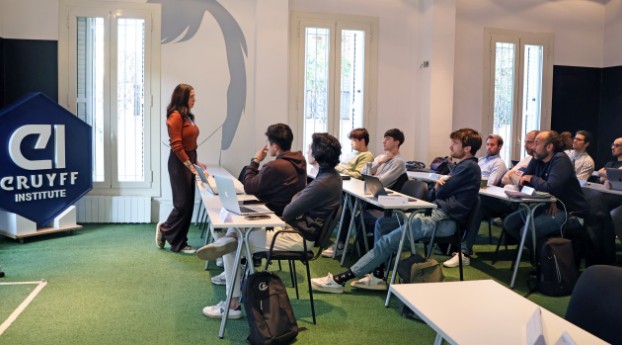
A couple of years ago, I was awarded a scholarship jointly granted by the Johan Cruyff Institute and AEMED Asociación Española de Mujer, Ejecutivas y Deporte to study the Master in Football Business in partnership with FC Barcelona. That year was intense: balancing the demands of the master’s with my responsibilities as Production Manager at LALIGA TV International became a real personal and professional challenge.
In that edition, only three women were awarded scholarships. We were the only women in the entire class. This led me to reflect on the low visibility of women in certain leadership spaces within the football and sports industry. I realized that, on one hand, there are still very few visible female role models, and on the other, many women (myself included at times) don’t fully recognize themselves as such. And if we don’t recognize ourselves, how can we inspire others? I also noticed something striking: there were no female lecturers.
That was the beginning of a meaningful and conscious dialogue with the Johan Cruyff Institute. From their openness and integrative vision, they offered me the opportunity to share my experience and expertise in media and broadcast across several of their master’s programs.
This past year, stepping into the role of teacher has been a true gift.
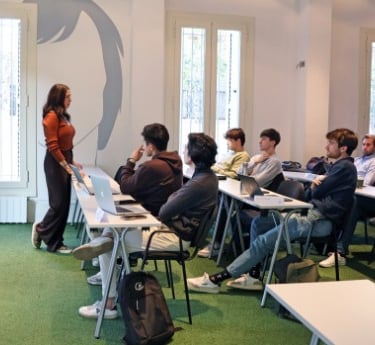
First, because I had the chance to serve the emerging talent that is shaping the future of our industry—something that has always given deep meaning to what I do. And second, because I’ve realized that teaching is not only about sharing knowledge, but about holding space for growth. I wasn’t just teaching about media, I was accompanying students through the final module projects, inviting them into a process of discovery and deeper alignment.
In that journey, I asked them to consider three essential pillars when building their ideas:
Social impact – How does your project leave a meaningful footprint? What change do you want to generate through it, big or small, within the sports world or beyond?
Feasibility and clarity – Is your idea truly executable? Is it grounded enough to be implemented either as an internal initiative in a company or as your own entrepreneurial venture?
Personal integration – Where are you in this project? What’s your role in it? What are you bringing that’s unique to your story, your background, your vision?
This last one often turned out to be the most difficult. Because we haven’t been taught to include ourselves in our ideas. The traditional educational system has trained us to learn data, reproduce it, pass tests. But that doesn’t teach us to imagine, position ourselves, or bring our own voice into what we create.
That’s the shift I tried to guide them into, a new paradigm where what you build is born not just from what you know, but from what moves you. It’s not enough to have a great idea. It must connect with something that excites you, and then be shaped into something real. Because ideas, if not embodied, eventually fade.
So we worked to refine each project into something concrete and alive. Something that could be presented as a business proposal to a company, or launched as a personal venture. Something sustainable, both economically and emotionally. And above all, something that carried their essence.
Because when you clearly define your place in your own idea—your “why”, your “from where”, your unique contribution, then your work becomes a mirror. It speaks of you, and it reaches others more deeply.
That’s what I love most about this process. That I didn’t feel like a traditional professor. I felt like a guide. Someone who brings her experience to serve the journey of others. Someone who holds space and asks real questions. And in doing so, grows too.
Because teaching, when done from truth, is always mutual. In every question I ask, I ask myself too. In every story they share, I recognize something of my own. In every project, I see seeds of possibility.
Next year, I’ll continue, and deepen, my involvement with the Johan Cruyff Institute, expanding my role and being even closer to the students. I want to keep opening doors, offering presence, and most of all, continue to inspire and be inspired.
Thank you to the Johan Cruyff Institute for your trust and vision. And thank you, from the heart, to every student who allowed me to accompany them. It’s been a beautiful, powerful journey. One that has transformed me too.